Family Services
Major Components of the CEC Family Services Program
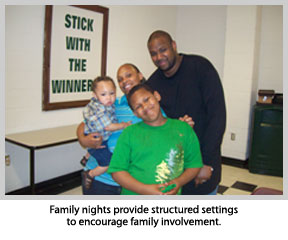 CEC is committed to the participation of family members in all of its programs, as research indicates that pro-social family support is crucial to a resident's successful reentry. The main components of the CEC family services model are: the genogram; Family Night; the psychoeducational component, i.e., the family services curriculum; ongoing individual, family, and/or couples therapy provided by trained family therapists under supervision of a licensed family therapist; and preparation for continuing care. CEC is committed to the participation of family members in all of its programs, as research indicates that pro-social family support is crucial to a resident's successful reentry. The main components of the CEC family services model are: the genogram; Family Night; the psychoeducational component, i.e., the family services curriculum; ongoing individual, family, and/or couples therapy provided by trained family therapists under supervision of a licensed family therapist; and preparation for continuing care.
Genogram
Each resident constructs a genogram upon entry to help identify the significant others who will participate in treatment. The genogram also serves to assess the resident's family strengths, as well as family history of psychiatric problems, substance abuse, and criminality. Futhermore, the genogram also provides the resident with a graphic description of his family history and current configuration.
Family Night
Once a week, family members who have been approved for visits, are invited to participate in psychoeducational groups during Family Night. During the first part of the night, the family members and residents attend counselor-facilitated group sessions focused on the effects of incarceration on family dynamics. The second half of the night involves a family visit, during which residents and guests are provided an opportunity to employ the positive skills and behaviors gleaned from the program. The goal of Family Night is to encourage family and resident involvement within the context of a therapeutic climate. The following are examples of topics discussed weekly during Family Night:
- Parenting Skills
- Fathering
- Co-Parenting
- Self-Esteem
- Recovery for the Family
- Life Skills
- Thinking and Distortions
- Forgiveness & Healing
- Grief & Loss
- Gaining Control
- Alcohol, Drug and Emotional Problems Boundaries
- Anger
- Adult Children of Alcoholics
- Addiction and Change
- Communication Skills
- Domestic Violence
- Features of Addiction
- Problem Identification
- Addictive Thinking Patterns
- Denial
- "Making It Clean"
- Roles
- Normalcy
- Getting Reconnected
- When A Loved One Uses Drugs
- Addictive Thinking Patterns
- Family Denial/Enabling
The Curriculum
Families often lack knowledge about the problems faced by the reentry population and are unaware of the types of services that residents require upon release. It is important that family members and significant others are familiar with the concepts and information that the residents are receiving, so that all parties may work together to promote a healthy lifestyle for the resident. Therefore, the family services model is designed to be integrated with the curriculum delivered to residents during their daily treatment as CEC program participants. The curriculum is designed to be used in four distinct ways: lecture, lecture with group participation, small group discussions, and specialty group discussions.
The curriculum is based on the four cornerstones of family wellness:
- Improve and develop communication skills
- Improve and develop problem solving skills
- Improve and develop your capacity for self-regulation
- Develop a process of forgiveness and healing of past hurts
In order to teach and develop these skills and abilities, the family services curriculum focuses on areas of "differentness" between family members, significant others, and residents in order to promote cooperative rather than conflictual relationships. For couples, some of these areas include: money, extended family relationships, sex, recreation and friendship, work and career, child rearing, household responsibilities, and religious and spiritual growth. It is through examination of such issues and the development of the aforementioned cornerstones, that residents and their loved ones can begin to build positive, pro-social relationships.
Individual, Family, and Couples Counseling
Family and/or couple therapy is available to all residents. The goals of these services are to incorporate the family into the resident's reentry preparation and to assist in a process of reintegration into the couple/family system. Families can enhance the treatment process by being supportive and caring or hinder a resident's successful reentry by being emotionally non-supportive and distant.
Couple/family therapy may highlight the need for the resident to separate from the family of origin and/or couple dyad and deal with issues such as grief and loss, dysfunctionality, and conflict. It sometimes involves teaching a resident how to function as part of a family wherever he finds himself. Having positive relationships in a wide variety of settings is part of the process.
Therapy is usually once a week, during a 50 minute session. Family members are encouraged to participate in face-to-face sessions; however, phone sessions may be conducted if the circumstances require. Therapy is often continued throughout the resident's stay, although it may be terminated prematurely if treatment goals have been accomplished prior to the discharge date, the therapy is deemed counterproductive, or upon resident request.
| 


